Free Java Update 8
Version 8 Update 481
Release date: January 20, 2026

Important Oracle Java License Information
The Oracle Java License changed for releases starting April 16, 2019.
The Oracle Technology Network License Agreement for Oracle Java SE is substantially different from prior Oracle Java licenses. This license permits certain uses, such as personal use and development use, at no cost -- but other uses authorized under prior Oracle Java licenses may no longer be available. Please review the terms carefully before downloading and using this product. An FAQ is available here.Commercial license and support is available with a low cost Java SE Subscription.
Oracle also provides the latest OpenJDK release under the open source GPL License at jdk.java.net.
Your system currently has an older version of Java and you are receiving this update notification because a newer version has been automatically detected.
This release addresses security concerns. Oracle strongly recommends that all Java SE 8 users upgrade to this release.
Please install this free Java Update by clicking on the Update button on the Java Update window.
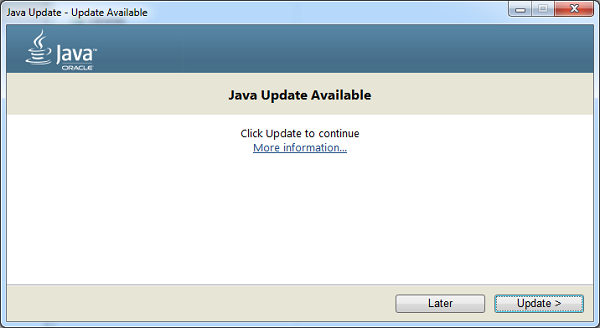
 Installing this update will ensure that your Java applications continue to run as safely and efficiently as always.
Release Highlights
- JDK 8u481 contains IANA time zone data 2025b .
For more information, refer to Timezone Data Versions in the JRE Software. - New Features: Endpoint Identification Enabled By Default for RMI Connections Over TLS
RMI will use TLS connections if the [javax.rmi.ssl.SslRMIClientSocketFactory] class is used. These connections now have TLS endpoint identification enabled by default. This may cause some previously-working TLS connections to fail. If this occurs, ensure that the certificate presented by the server has aSubject Alternative Namethat matches the server's hostname. Alternatively, endpoint identification for RMI TLS connections can be disabled on the client side by setting thejdk.rmi.ssl.client.enableEndpointIdentificationsystem property tofalse.
JDK-8341496 (not public) - Other Notes: Disabled SHA-1 in TLS 1.2 and DTLS 1.2 Handshake Signatures
The SHA-1 algorithm has been disabled by default in TLS 1.2 and DTLS 1.2 handshake signatures, by adding"rsa_pkcs1_sha1 usage HandshakeSignature, ecdsa_sha1 usage HandshakeSignature, dsa_sha1 usage HandshakeSignature"to thejdk.tls.disabledAlgorithmssecurity property in thejava.securityconfig file. RFC 9155 deprecates the use of SHA-1 in TLS 1.2 and DTLS 1.2 digital signatures. Users can, at their own risk, re-enable the SHA-1 algorithm in TLS 1.2 and DTLS 1.2 handshake signatures by removing"rsa_pkcs1_sha1 usage HandshakeSignature, ecdsa_sha1 usage HandshakeSignature, dsa_sha1 usage HandshakeSignature"from thejdk.tls.disabledAlgorithmssecurity property.
See JDK-8340321 - Other Notes: Disabled TLS_RSA Cipher Suites
The TLS_RSA cipher suites have been disabled by default, by adding "TLS_RSA_" to thejdk.tls.disabledAlgorithmssecurity property in thejava.securityconfiguration file. The TLS_RSA cipher suites do not preserve forward-secrecy and are not commonly used. Some TLS_RSA cipher suites are already disabled because they use DES, 3DES, RC4, or NULL, which are disabled. This action disables all remaining TLS_RSA cipher suites. Any attempts to use cipher suites starting with "TLS_RSA_" will fail with anSSLHandshakeException. Users can, at their own risk, re-enable these cipher suites by removing "TLS_RSA_" from thejdk.tls.disabledAlgorithmssecurity property. The following previously enabled cipher suites are now disabled:TLS_RSA_WITH_AES_256_GCM_SHA384
TLS_RSA_WITH_AES_128_GCM_SHA256
TLS_RSA_WITH_AES_256_CBC_SHA256
TLS_RSA_WITH_AES_128_CBC_SHA256
TLS_RSA_WITH_AES_256_CBC_SHA
TLS_RSA_WITH_AES_128_CBC_SHA
See JDK-8245545
Bug Fixes
This release also contains fixes for security vulnerabilities described in the Oracle Critical Patch Update. For a more complete list of the bug fixes included in this release, see 8u481 Release notes.
Java Expiration Date
Oracle recommends that the JDK is updated with each Critical Patch Update. In order to determine if a release is the latest, the Security Baseline page can be used to determine which is the latest version for each release family.
Critical patch updates, which contain security vulnerability fixes, are announced one year in advance on Critical Patch Updates, Security Alerts and Bulletins. It is not recommended that this JDK (version 8u481) be used after the next critical patch update scheduled for April 21, 2026.
Java Management Service, available to all users, can help you find vulnerable Java versions in your systems. Java SE Subscribers and customers running in Oracle Cloud can use Java Management Service to update Java Runtimes and to do further security reviews like identifying potentially vulnerable third party libraries used by your Java programs. Existing Java Management Service user click here to log in to your dashboard. The Java Management Service Documentation provides a list of features available to everyone and those available only to customers. Learn more about using Java Management Service to monitor and secure your Java Installations.
For systems unable to reach the Oracle Servers, a secondary mechanism expires this JRE (version 8u481) on 2026-05-21. After either condition is met (new release becoming available or expiration date reached), the JRE will provide additional warnings and reminders to users to update to the newer version. For more information, see 23.1.2 JRE Expiration Date in the Java Platform, Standard Edition Deployment Guide.
Related Information
» More information on Java Update
» Detailed technical information about this release can be found in the Java 8 Release Notes.
» Previous release changes FAQ